
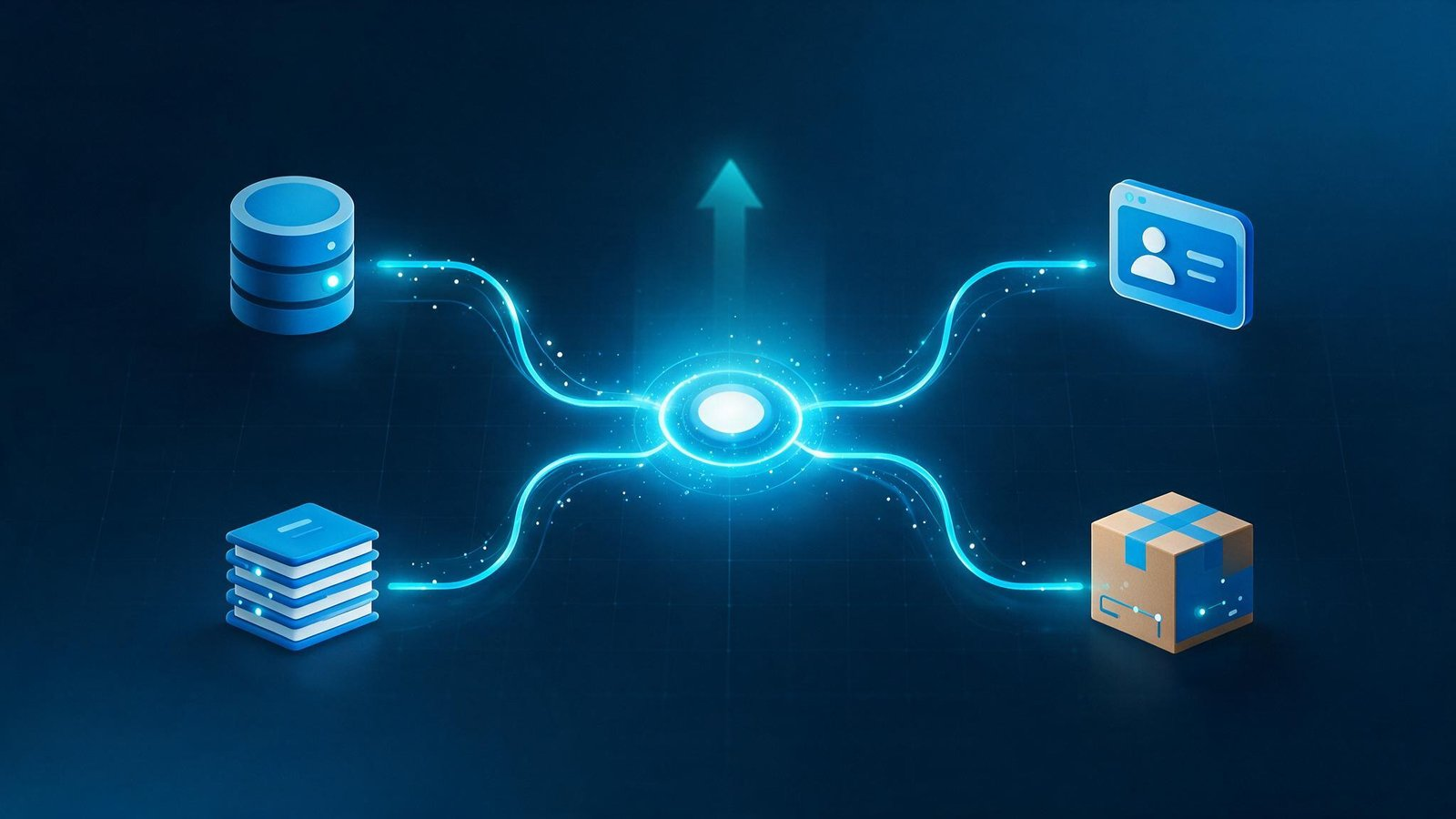
Every executive team is under pressure to show an AI roadmap. Fewer are asking whether their ERP environment is actually ready for one. The instinct is to reach for AI first — a forecasting model here, a Copilot pilot there — while the systems underneath stay exactly as disconnected as they were before. That sequencing choice is why so many AI initiatives produce a demo, not a result.
DAX Software Solutions works with organizations running Microsoft Dynamics 365 to build the connected foundation AI actually needs — because AI cannot operate effectively in disconnected systems, no matter how capable the model is.
The AI Adoption Rush — and Why It’s Stalling
Board-level pressure to “do something with AI” has pushed many organizations to pilot tools before addressing the systems those tools depend on. The result is a familiar pattern: a promising proof of concept that never scales, because it was built on top of the same fragmented data and disconnected systems that caused the original decision-making problem.
AI adoption stalls not because the technology underperforms, but because it’s asked to operate on a foundation that was never built to support it. An AI model is only as good as the data it can see — when ERP, CRM, and finance systems don’t share data consistently, AI ends up working from a partial, delayed, or inconsistent view of the business.
Common failure patterns when intelligence outruns integration:
- Forecasts built on one system’s data while the true signal sits in another, unconnected system.
- Exception-flagging tools that miss exceptions because the source data never reached them.
- Pilots that work in a demo environment but can’t scale to production because the integration work was never done.
What “AI-Ready” Actually Means for ERP

AI-ready ERP is an environment where systems are connected, data flows near real-time, and governance is established — so that when AI is introduced, it has a reliable foundation to work from. Intelligence is the last layer added, not the first.
AI-ready ERP means:
- Systems are connected — ERP, CRM, and finance platforms share data instead of requiring manual export/import between them.
- Data flows near real-time, not on a weekly batch cycle that leaves AI working from stale information.
- Governance is in place — clear data ownership and validation, so AI isn’t amplifying an existing data-quality problem.
- Human oversight is built into the design, not added after something goes wrong.
None of this is exotic. It’s the operational discipline AI adoption has always required — it’s just often skipped in the rush to show progress.
Building the Foundation: A Sequenced Path
Getting there follows a sequence, and skipping a step doesn’t save time — it just moves the cost later, where it’s more expensive and more visible to fix.
- Audit system connections. Map how data actually moves between ERP, CRM, and finance systems today — this step alone often explains why existing dashboards and reports don’t match.
- Build the integration layer. Connect the systems so data moves between them near real-time instead of through manual exports. This is the role an integration platform like Aonflow, DAX’s integration platform, plays: providing the connective layer AI-driven insight will eventually depend on.
- Govern the data flowing through it. Establish clear ownership, validation rules, and master-data discipline before layering on AI. A newly connected system will expose inconsistencies that were previously hidden across silos — AI doesn’t fix bad data, it exposes it faster.
- Layer AI on the connected foundation. Only now does AI-driven insight become a reliable addition: surfacing exceptions, forecasts, and trends from a consistent data set, with a person accountable for reviewing and acting on what it surfaces.
Governing Principles: Sequencing Discipline
Every step above rests on the same principle: readiness is sequential. Integration comes before data governance; data governance comes before AI. This is controlled autonomy in practice — AI accelerates the path to a decision; it does not replace the governance around it. Reversing the order tends to surface and amplify existing data problems rather than resolve them.
Signs Your ERP Is (or Isn’t) AI-Ready

Signs the foundation isn’t ready yet:
- Reports from different departments routinely disagree on the same number.
- Data moves between systems on a manual or batch schedule, not near real-time.
- No single owner is accountable for a given data domain’s accuracy.
Signs the foundation is ready:
- Systems share data automatically, near real-time.
- There’s a single source of truth for core entities like customers and items.
- Governance roles and validation rules are defined, not improvised.
As more competitors build the integration layer their AI initiatives need, the relative cost of staying disconnected rises — organizations that treat integration as optional aren’t simply moving slower on AI, they’re compounding the gap between their decision speed and the market’s.
DAX Software Solutions: Your Partner in AI-Ready ERP
AI readiness isn’t a feature to switch on — it’s a foundation built in sequence: integrate first, govern second, layer in AI-driven insight third. DAX Software Solutions helps organizations answer the question that matters most before any AI investment — can your systems actually talk to each other, reliably, near real-time — and build toward AI-ready ERP on Dynamics 365 with Aonflow as the connective layer underneath it.