

Most documents called an “AI roadmap” are really a pitch with a timeline attached. They describe what a tool can do and when it might be available, but they skip the questions an executive actually needs answered before committing budget: what does this run on, whose data does it touch, who’s accountable if it’s wrong, and where does it start.
DAX Software Solutions builds AI conversations around Microsoft Dynamics 365 as an actual blueprint, not a pitch — a document with enough substance that an executive could hand it to their own team and expect a straight answer to every one of those questions.
Why Most AI Proposals Aren’t Actually Blueprints
A pitch shows a demo and a vision. A blueprint shows a plan: what it’s built on, what it needs to work reliably, what could go wrong, and where the organization starts. A pitch can get approved on enthusiasm; a blueprint gets approved on evidence — and only a blueprint survives contact with an actual budget cycle.
Before calling a document a blueprint, it should be able to answer:
- What does the user actually see and do differently? (Applications)
- Whose data does this depend on, and is that data trustworthy? (Data and governance)
- What compute, storage, and networking does this actually require at scale? (Infrastructure)
- Who can access this, and what happens if something goes wrong? (Security)
- What gets built first, second, and third — and with which named products? (Phased roadmap)
- What could derail this, and is the organization actually ready? (Risks and readiness)
If a document can’t answer all six, it’s a pitch wearing a blueprint’s name.
The Six Components of a Real Blueprint

Applications name the specific workload — a Dynamics 365 Finance exception queue, a Customer Service case-summarization flow — rather than describing “AI” in the abstract.
Data and governance specify exactly what data the application needs, where it lives today, who owns it, and whether it moves near real-time or on a batch delay that will limit what the application can do. AI doesn’t fix bad data. It exposes it faster — which is exactly why this section can’t be an afterthought.
Infrastructure is sized for the target state, not the version that ran cleanly in a conference-room demo: compute, storage, and networking built for actual production volume.
Security is defined upfront — identity, access controls, and compliance requirements — not retrofitted after a pilot succeeds and the organization tries to scale it.
The Phased Roadmap: Named Products, Not Vague Promises
A credible blueprint doesn’t just say “you’ll need integration” or “you’ll need identity management.” It names the actual product, which phase it lands in, and where it comes from — Microsoft Entra ID for identity, Azure Logic Apps or an integration platform like Aonflow for connective workflows, Dataverse for governed data — along with who owns delivering it. Vague roadmap language is usually a sign the underlying plan hasn’t been thought through.
Risks, Dependencies, and Organizational Readiness
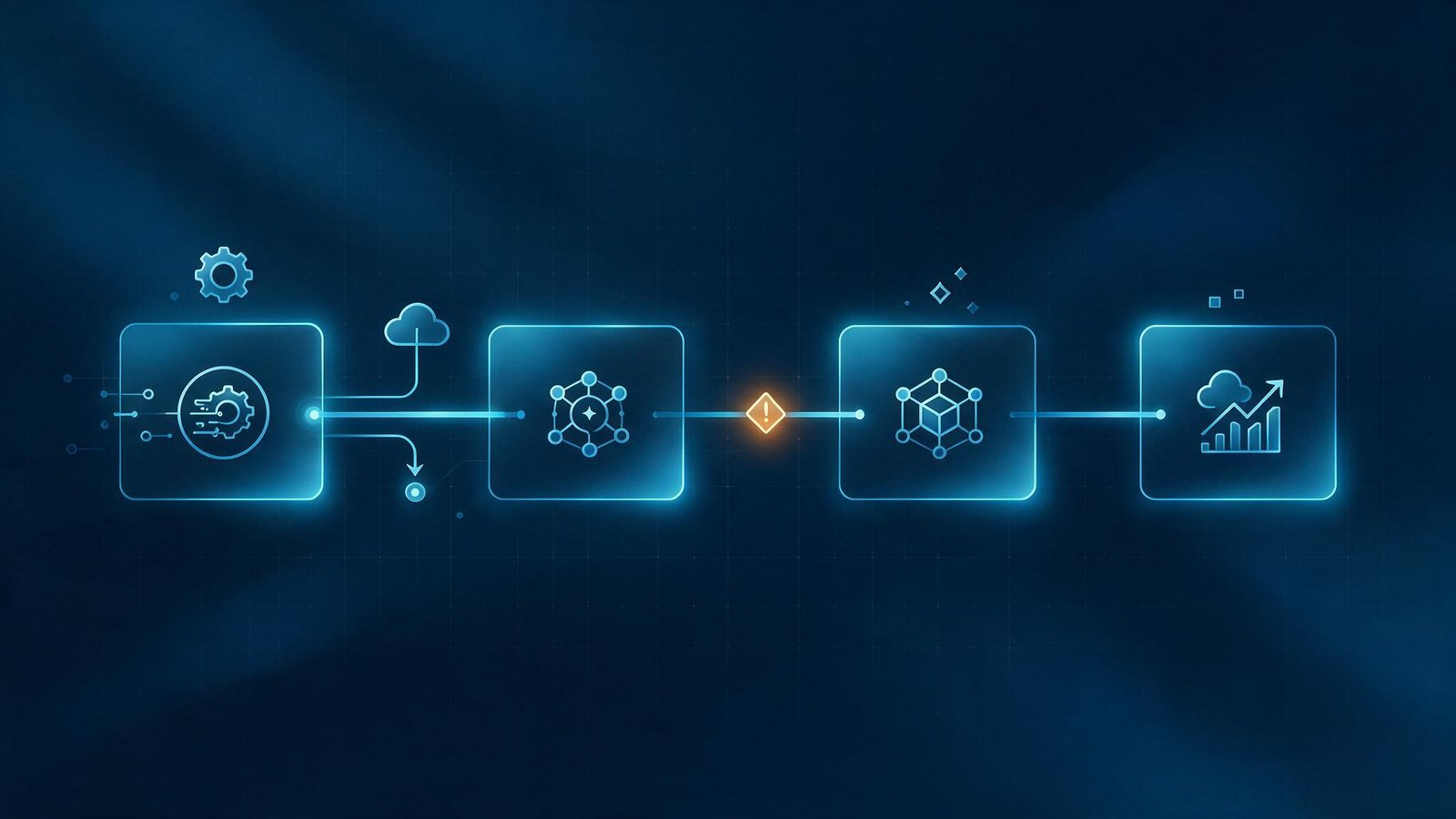
The final component should be honest about:
- What has to be true elsewhere in the organization for this to succeed (data quality, executive sponsorship, change management capacity).
- What dependencies exist between phases — what has to ship before the next phase can start.
- Whether the organization is actually ready, or whether readiness work has to happen first.
Skipping this component is how AI initiatives get approved on hope and stall on reality six months later.
Starting Narrow: The First Proof of Concept
The strongest blueprints recommend starting narrow: one measurable metric, one tightly scoped workflow, before expanding. A proof of concept scoped this way is small enough to deliver quickly and specific enough to prove or disprove the approach — rather than a broad pilot that’s hard to evaluate either way.
DAX Software Solutions: Building Blueprints, Not Pitches
An AI initiative that starts with a demo and skips the plan underneath it rarely survives its first budget review. DAX Software Solutions builds Dynamics 365 AI blueprints that answer all six questions — applications, data, infrastructure, security, phased roadmap, and risk — so the plan can actually be executed, not just approved.