
Most leadership teams have already settled whether to adopt agentic AI. Budget exists, the board has asked, and someone has been asked to show progress this quarter. The open question is narrower and more consequential: which process goes first. That decision is often made in a single meeting, usually by selecting the process with the most executive visibility rather than the one most likely to succeed.
It matters because the first deployment sets the organization’s tolerance for the next ten. A first agent that quietly clears a backlog earns the mandate to expand. A first agent that pushes a wrong figure into a finance process can set the programme back well beyond the pilot. At DAX Software Solutions, we help organizations sequence agentic adoption inside Microsoft Dynamics 365 so the first deployment is scoped deliberately rather than opportunistically, and so human oversight is designed in from the start rather than added after an incident.
Why the First Agent Decision Carries Disproportionate Weight
The cost of a failed first agent is rarely the cost of the project. It is the cost of the credibility that goes with it.
When an agent misfires somewhere finance, audit, or a major customer can see, the response is predictable. Oversight tightens everywhere, approval gates multiply, and the next three proposals are declined on principle rather than on merit. The technology did not fail. The sequencing did.
One distinction is worth holding onto. Copilot assists a person who stays in control of the action, while an agent pursues a goal and can act on its own within a boundary. Only the second raises the question this article is about.
What Makes a Process a Good First Candidate for an Agent?
A process is a good first candidate when four conditions hold together: repeatable volume, governed inputs, reversible actions, and observable results. Any one of them failing is a reason to look elsewhere.
- Volume with low variability. The work repeats often and looks broadly the same each time, which allows performance to be evaluated against a meaningful sample.
- Structured, trustworthy inputs. The data already lives in a governed system rather than in a mailbox or a spreadsheet. Agents do not compensate for poor data, they surface it faster.
- Reversibility. A mistake can be caught before it reaches a customer, a regulator, or a bank account.
- Observability. Someone can see what the agent did and why, and a defined owner is accountable for the outcome.
Applied honestly, these criteria disqualify most of the processes leadership teams nominate first. Period-end close, revenue recognition, and credit decisions are attractive precisely because they are painful, but they are judgement-heavy, exception-rich, and subject to audit. Autonomy should arrive there last.
Where Microsoft Has Already Done the Engineering
Microsoft’s own product sequencing is a useful guide, because it shows where Microsoft chose to invest engineering effort first.
In Dynamics 365 Business Central, Microsoft’s Payables Agent is generally available. It monitors a designated mailbox for vendor invoices, extracts invoice content using Azure Document Intelligence, identifies the vendor, drafts the purchase document, and presents that draft to a designated agent supervisor, with review depth set by configuration and the agent’s confidence. The boundaries are documented as clearly as the capability. New vendors the agent creates stay blocked until a person unblocks them, approval flows and anomaly detection are not currently supported, and Microsoft publishes explicit per-document and per-day processing limits. This is a Business Central capability specifically, and Finance & Operations customers have a different agent set.
In Dynamics 365 Sales, Microsoft’s agents include the Sales Qualification Agent, configurable in a research-only mode or a research-and-engage mode with defined handoff criteria. Across Dynamics 365 Customer Service and Contact Center, four agents including the Case Management Agent reached general availability in October 2025.
What that pattern tells an executive:
- Microsoft is starting with structured, high-volume intake work, not judgement work.
- Autonomy is scoped and configurable rather than absolute.
- A supervisory human role is built into the design rather than offered as an option.
- Agent runs consume Copilot Credits, so pilot scope carries a per-transaction cost, not only a licence cost.
Processes Microsoft has not already covered belong in Microsoft Copilot Studio, and that is a later decision rather than a first one.
What to Automate First: A Practical Sequence
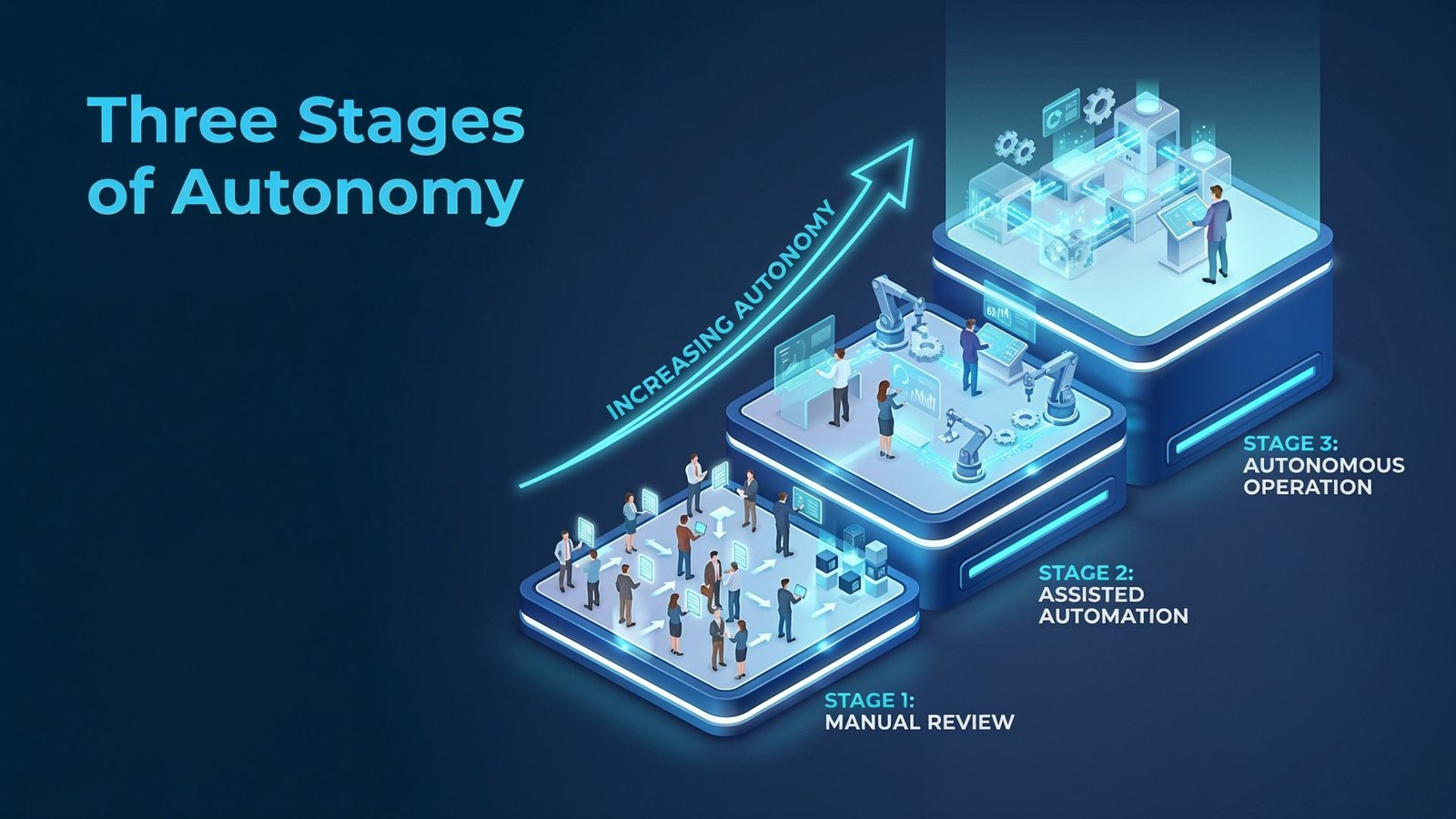
Autonomy is a dial, not a switch, and the order in which it is turned up matters more than where it eventually lands. Three stages, not to be confused with Microsoft’s release waves.
- Stage one, assisted. The agent prepares and proposes, and a person confirms every instance. The objective is a measured confidence rate, not throughput.
- Stage two, bounded autonomy. The agent completes the routine case unattended inside explicit limits, including value and confidence thresholds, and escalates everything else.
- Stage three, supervised autonomy at scale. The process runs unattended within its boundary, with people reviewing exceptions and aggregate performance rather than individual transactions.
Stage three is available only where the product supports it, and several shipped Dynamics 365 agents still require supervisor review at documented steps. Expect to stay in stage one longer than planned. Moving on before the confidence rate is known means the boundary was set on optimism.
Where the Human Stays in the Loop

When AI only suggested, oversight was implicit, because a person was always the one who acted. When an agent acts, oversight has to be engineered into the process, because the system can now move without waiting at every step.
Four categories of decision should stay with people regardless of how mature the agent becomes. The discipline is matching the level of control to the consequence of the action rather than applying one gate everywhere.
- Irreversible or high-value actions, including payments above an agreed threshold and contractual commitments.
- Genuine exceptions, where the case is novel, ambiguous, or disputed.
- Compliance-sensitive decisions, where accountability must sit with a named person.
- Low-confidence situations, where the data is thin or conflicting and pausing is safer than acting.
Define each checkpoint before go-live, not after an incident, and name the triggering action, the accountable role, the response time expected, and the evidence retained.
Making Oversight Auditable, Not Anecdotal
Oversight that exists only in a person’s judgement cannot be evidenced to an auditor. Oversight that exists in the platform can.
Microsoft Agent 365 became generally available in May 2026 and provides a unified agent registry and control plane spanning the Microsoft 365 admin center, Microsoft Entra, and Microsoft Purview, giving administrators an inventory of the agents operating in the organization along with lifecycle, identity, and policy controls. The NIST AI Risk Management Framework offers vocabulary for the same question, covering how risk is identified, measured, and managed over time.
What an executive should expect to see documented:
- Which agents exist, who owns each one, and what each is permitted to do
- The data and permissions each agent operates under, and where human approval is mandatory
- How performance is monitored, and the criteria for widening or withdrawing autonomy
DAX Software Solutions: Your Partner in Sequenced Agentic ERP
Agentic capability in Dynamics 365 is no longer the constraint. Readiness is. In our experience, the organizations getting value are the ones that stabilize the ERP, fix data ownership, and connect the systems an agent will depend on before the first pilot is scoped.
DAX Software Solutions works with executive teams to make that sequence explicit. Our AI readiness assessments evaluate ERP stability, data quality, governance, and integration before any agent work begins, and our Agentic AI adoption framework moves organizations through ERP stabilization, data governance, integration, and then AI enablement, in that order. Our human-in-the-loop operating model work defines in advance which actions an agent may take alone, which it must propose, and who owns the result.
If your organization is deciding what to automate first, talk to DAX Software Solutions about an AI readiness assessment.