

Go-live day gets the applause. There is a countdown, a cutover weekend, and a congratulations email. Then the project team disbands, the consultants roll off, and the system is left to prove itself in daily operations. That is precisely where most ERP investments start to erode. Industry analyses consistently place the ERP failure rate between 55% and 75%, and in most of those cases failure does not mean the system was switched off. It means the business quietly stopped getting what it paid for.
The Myth of the Finish Line
Implementation teams are measured on going live on time and on budget. The business, however, is measured on what happens afterward. Research shows that 51% of companies experience operational disruption when their ERP goes live, and small and mid-sized businesses typically need 11 to 14 months after go-live to fully realize the financial benefits they projected. The system may be technically complete on day one. It is not operationally proven for another year.
Recent high-profile cases underline the point. Analyses of 2025 implementation failures found that organizations frequently went live before systems were ready, then struggled with order fulfillment, invoicing, and basic reporting. The same research recommends budgeting for a stabilization period of three to six months, maintaining backup processes, and standing up rapid issue resolution during that window. Very few mid-market organizations actually plan for this.
How Strong Systems Become Weak Ones
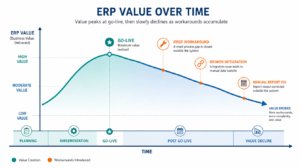
Post-go-live decline follows a predictable pattern. A report takes too long, so a manager exports to Excel. An integration mapping breaks silently, so a coordinator re-keys data between systems. A new product line launches, but the configuration never catches up. None of these moments feels like failure. Together, they are exactly how failure looks in practice. Gartner-cited research finds that 55% to 75% of ERP implementations fail to achieve expected ROI due to low user adoption, weak data governance, and poor post-implementation optimization, and that more than 60% of ERP data issues originate from integration failures.
This is why well-designed integrations matter as much after go-live as before it. APIs change, volumes grow, and new applications join the landscape. An integration architecture that connects Dynamics 365 with surrounding systems needs monitoring and periodic review, not a one-time setup. When data flow degrades, trust degrades with it, and users retreat to spreadsheets.
What a Post-Go-Live Health Check Actually Measures
A health check is not an audit of blame. It is a structured comparison between how the system was designed to work and how the business actually operates today. In practice it covers four areas. First, adoption: which modules and features are genuinely used, and where users have built workarounds. Second, data quality: duplicates, stale master data, and reconciliation effort, since poor data migration remains one of the top causes of ERP failure alongside inadequate change management. Third, integration health: whether interfaces still run correctly at current volumes. Fourth, alignment: whether the configuration still matches processes that have inevitably changed since design workshops were held.
For organizations on Microsoft Dynamics 365, regular platform updates make this discipline easier to sustain, because capabilities the business paid for keep arriving. A health check identifies which of those capabilities can replace customizations and manual steps. For mid-market companies running Dynamics 365 Business Central, the same review often uncovers unused financial automation that directly improves close cycles and cash visibility.

A Practical Rhythm for Protecting ERP Value
The organizations that keep their ERP strong treat optimization as a rhythm, not a rescue. A first health check around six months after go-live, when the stabilization period ends and real usage patterns are visible. An annual review after that, timed ahead of budget planning so findings can be funded. And a defined owner for the system’s ongoing fit, because a platform that belongs to everyone effectively belongs to no one. Deciding which platforms should connect to the ERP next, and retiring integrations that no longer earn their maintenance cost, belongs in that same annual conversation.
The uncomfortable truth in the statistics is also the encouraging one. Most ERP failure is gradual, and gradual failure is catchable. The gap between a system that compounds value and one that quietly decays is usually a few disciplined reviews a year.
Go-live was the beginning, not the finish line.
To schedule a post-go-live health check for your Dynamics 365 environment, visit daxsws.com.