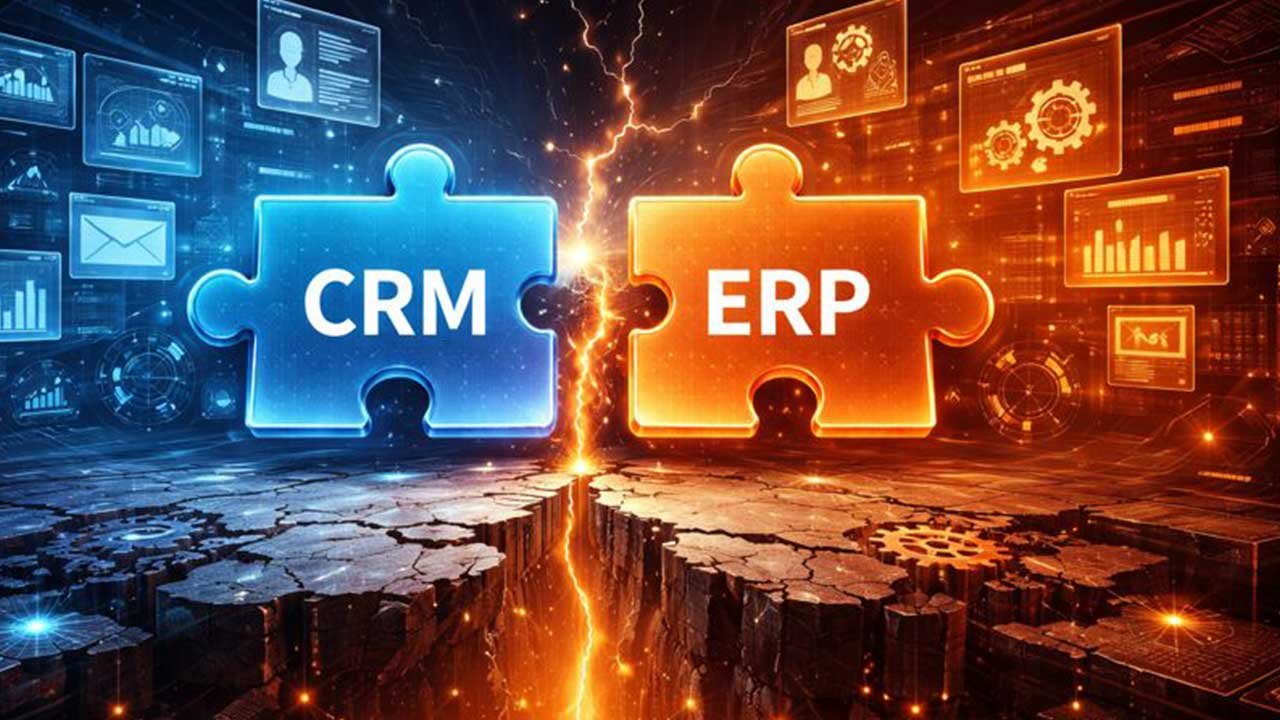
Customer Relationship Management and Enterprise Resource Planning systems serve different but interconnected purposes within an organization. CRM platforms focus on managing customer interactions, sales activities, and service engagement. ERP systems manage financials, supply chain, operations, and compliance. When these systems are not properly aligned, operational risk increases across departments.
Many organizations implement CRM and ERP as separate initiatives. Over time, this separation creates gaps in data consistency, process ownership, and reporting accuracy. These gaps are not always immediately visible but tend to surface as the business scales or as transaction volumes increase.
At DAX Software Solutions, CRM and ERP alignment is treated as an operational requirement rather than a technical enhancement. Understanding how misalignment creates risk helps organizations address issues before they impact revenue, customer satisfaction, or financial accuracy.
How Misalignment Develops Between CRM and ERP
CRM and ERP misalignment usually develops gradually. Early integrations may focus only on basic data exchange, such as syncing customers or orders. As processes evolve, additional data fields, validation rules, and workflows are introduced. Without a structured approach, integrations become inconsistent.
One common issue is duplicate data creation. Sales teams may create customers in the CRM while finance teams maintain customer records in the ERP. If synchronization rules are unclear, records may be duplicated or overwritten. This leads to confusion about which system contains accurate information.
Another issue arises when process timing is not aligned. For example, a sales order may be marked as confirmed in the CRM before pricing, credit approval, or inventory availability is validated in the ERP. This creates downstream issues when commitments made in the CRM cannot be fulfilled operationally.
Operational Impact on Sales and Finance
Misalignment between CRM and ERP directly affects sales and finance operations. Sales teams rely on CRM data to forecast revenue and manage pipelines. Finance teams rely on ERP data for billing, revenue recognition, and compliance.
When CRM data does not accurately reflect ERP status, forecasts become unreliable. Orders that appear confirmed in CRM may be delayed or rejected in ERP due to credit limits or pricing issues. This creates friction between teams and undermines trust in system data.
From a finance perspective, incomplete or delayed data synchronization can impact invoicing accuracy. Missing order details, incorrect customer classifications, or delayed postings can result in billing errors and reconciliation challenges.
DAX Software Solutions addresses these risks by aligning CRM and ERP processes rather than focusing solely on data synchronization. This ensures that system behavior reflects operational reality.
Customer Experience and Service Challenges

CRM systems often serve as the primary interface for customer-facing teams. Service agents and account managers depend on CRM data to respond to inquiries, manage cases, and track customer history.
When ERP data such as order status, shipment details, or payment information is not accurately reflected in the CRM, customer-facing teams lack visibility. This can result in delayed responses, inconsistent communication, and reduced customer confidence.
Misalignment also complicates issue resolution. Service teams may need to consult multiple systems or request information from back-office teams, increasing resolution time. Proper alignment ensures that CRM users have access to reliable ERP-derived information without manual intervention.
Reporting and Decision-Making Risks
Executives often expect consolidated reporting across CRM and ERP. When data definitions and timing differ between systems, reports may produce conflicting results.
For example, revenue figures derived from CRM opportunities may not align with ERP financial postings. Customer profitability analysis may be distorted if cost data from ERP is not accurately linked to CRM accounts.
These inconsistencies make decision-making more difficult. Leaders may question the accuracy of reports or delay decisions while data is reconciled manually.
DAX Software Solutions helps organizations define shared reporting models that align CRM and ERP data structures. This supports consistent analytics and reduces reliance on manual adjustments.
Integration Design as a Risk Control
Integration design plays a central role in mitigating CRM and ERP misalignment. Effective integration establishes clear rules for data ownership, synchronization timing, and validation.
Rather than allowing unrestricted updates from both systems, integrations should enforce controlled workflows. For example, customer master data may be maintained in ERP while CRM manages relationship-specific attributes. Orders may originate in CRM but be validated and finalized in ERP.
This approach reduces ambiguity and ensures that each system operates within defined boundaries. Integration monitoring and logging further reduce risk by providing visibility into transaction status and failures.
Governance and Change Management

CRM and ERP alignment is not a one-time effort. As organizations introduce new products, pricing models, or sales channels, integration logic must be reviewed and adjusted.
Without governance, incremental changes introduce inconsistencies. New fields may be added to CRM without corresponding ERP mappings. Process changes may bypass existing validation rules.
DAX Software Solutions emphasizes governance as part of alignment strategy. This includes documentation, change review processes, and coordination between business and technical teams.
Aligning Systems to Support Operations
CRM and ERP systems are most effective when they operate as coordinated components of a broader operational ecosystem. Alignment reduces manual work, improves data reliability, and supports scalable growth.
By addressing integration design, process ownership, and governance, organizations can reduce operational risk and improve collaboration between teams. DAX Software Solutions supports this alignment by combining Dynamics 365 expertise with a practical understanding of business operations.
The result is not simply connected systems, but systems that work together to support accurate execution and informed decision-making.