
Introduction
The speed of a business is often not limited by the software it uses. It is limited by how quickly decision makers are willing to accept a better way of doing things. This is something often seen in Dynamics 365 ERP and CRM projects. Organizations begin with strong experience from their previous systems, processes, integrations, reports, and workflows. That experience is important because it reflects how the business has operated and what users are familiar with. However, experience should guide the discussion, not limit the solution.
When Experience Becomes a Limitation

Many customers come into ERP and CRM projects with a clear understanding of their existing systems. They know how data moved before, how reports were created, how approvals worked, and how integrations were built. This knowledge is valuable. It helps the implementation team understand business realities and avoid assumptions. But sometimes, the same knowledge becomes the ceiling. Instead of asking, “What is the best way to build this for the future?” the conversation becomes, “How do we make Dynamics 365 work like what we already understand?” That is where the project can start moving in the wrong direction.
The Risk of Recreating the Old System
Dynamics 365 is a flexible and powerful platform. It allows businesses to configure processes, customize workflows, build integrations, create reports, and automate operations. But flexibility must be used carefully. A common mistake in ERP and CRM projects is trying to make a modern platform behave like the old system. Existing processes are copied, old workarounds are rebuilt, and outdated reporting structures are recreated inside a new platform. In the beginning, this approach feels safe. Users recognize the process. Decision makers feel comfortable. Teams believe adoption will be easier because the new system looks and behaves like the old one. But comfort can become expensive.
How Technical Debt Starts

Technical debt does not always come from bad developers or poor technology. Many times, it comes from decisions made inside a comfort zone. When a Dynamics 365 solution is over-customized only to match familiar ways of working, the system may work in the short term, but it becomes harder to improve in the long term. The real cost appears later. It appears when upgrades become difficult, reporting becomes complex, integrations become fragile, and every new business requirement needs more custom code. It also appears when Microsoft releases new capabilities, but the organization cannot adopt them easily because the solution has been designed around old processes rather than future-ready standards.
Why AI and Automation Need a Clean Foundation
As AI and automation become more important in ERP and CRM environments, the quality of the system foundation becomes even more critical. AI cannot work effectively on fragmented processes, inconsistent data, or heavily customized workflows that were built only to recreate legacy behavior. Automation also becomes harder when processes are not standardized. If every department has a different workaround, every automation requires additional logic, exception handling, and maintenance. A future-ready Dynamics 365 implementation should support automation, reporting, AI readiness, scalability, and continuous improvement. That is difficult when the system is designed mainly for familiarity.
The Role of ERP Configuration and Guidance
This is where ERP systems and implementation partners need to play a stronger role. Technology should not simply allow every possible path. It should help guide better decisions. Stronger configuration options, standard process templates, and best-practice guidance can help organizations avoid unnecessary customization. The goal should be to encourage standardization, reduce outdated process replication, and push the organization toward scalable patterns. Because flexibility without guidance often leads to familiar choices, not better choices.
Leadership’s Role in Digital Transformation
Digital transformation is not only a technology decision. It is a leadership decision. The success of an ERP or CRM project depends not only on the platform, but also on how open the organization is to improving the way work gets done. modern Dynamics 365 implementation should not only ask, “Can we build it?” It should also ask, “Should we build it this way?” This question helps leadership move the project from short-term comfort to long-term value. It helps separate genuine business requirements from legacy habits.
The Role of a Good Implementation Partner
A good implementation partner should not only build what is requested. The partner should also challenge outdated assumptions, explain better options, and protect the customer from avoidable complexity.
This does not mean dismissing the customer’s experience. Customer knowledge is essential. It helps identify what has worked, what has failed, and what must be protected.
But experience should be used to improve the solution, not to recreate the past.
A strong implementation partner helps the customer understand when customization is necessary, when configuration is enough, and when a process should be redesigned instead of copied.
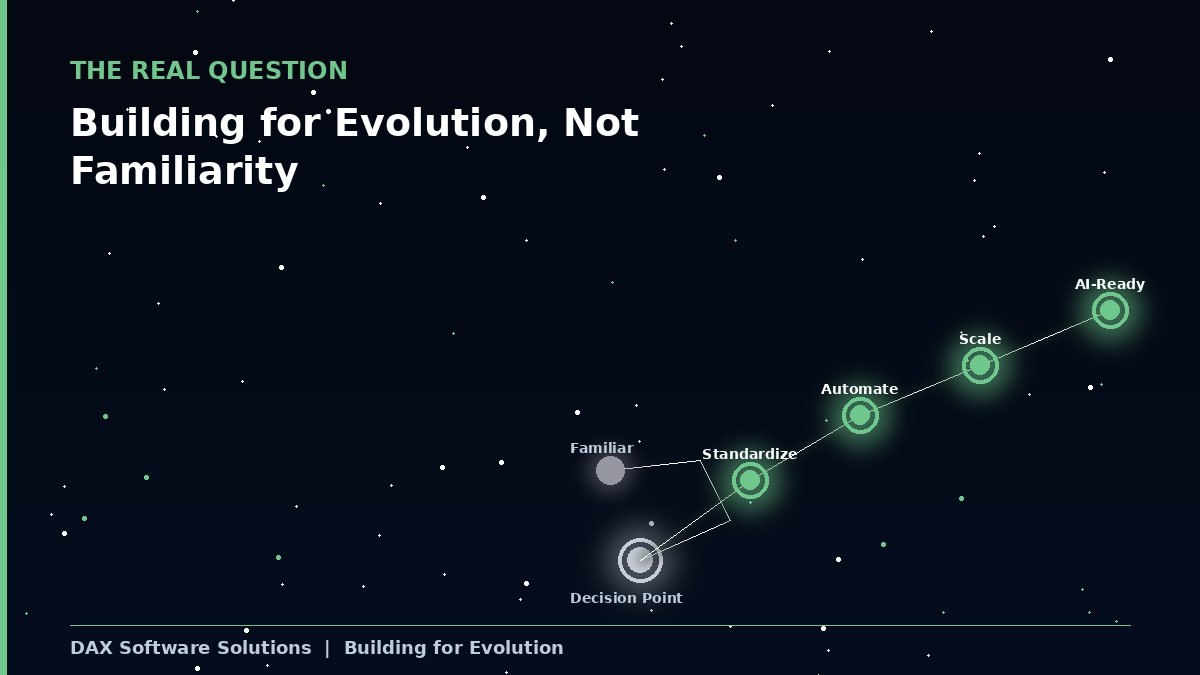
Building for Evolution, Not Familiarity

At some point, every organization must ask whether its ERP or CRM solution is designed for evolution or only for familiarity.
If the system is designed for familiarity, it may feel comfortable in the beginning, but it can limit future growth.
If the system is designed for evolution, it may require harder decisions in the beginning, but it creates a stronger foundation for scale, automation, reporting, upgrades, and AI adoption.
Continuous evolution is no longer optional. It is the cost of staying competitive.
Conclusion
The companies that move faster are not always the companies with the most technology. They are the companies where leadership is more willing to accept better options, even when those options challenge old habits.
Technology can provide flexibility. Leadership must decide how wisely that flexibility is used.
In Dynamics 365 ERP and CRM projects, the real question is not only whether something can be built.
The real question is whether it should be built that way.
That is where real transformation begins.