
In the modern enterprise, manual decision-making in ERP systems is often underestimated. While many organizations focus on improving operational workflows and streamlining processes, they overlook one critical area that significantly impacts efficiency and cost: decision-making. When decisions are made manually, inefficiencies quickly accumulate, resulting in delays, errors, and inconsistent outcomes. While these issues may seem small at first, they have a cumulative impact on business operations and ultimately contribute to higher operational costs.
This is where Agentic AI comes into play. By automating decision-making cycles, Agentic AI helps organizations transition from outdated, manual processes to intelligent, real-time decision-making, driving efficiency and accuracy across the entire ERP ecosystem.
The Hidden Costs of Manual Decision-Making
Manual decision-making in ERP systems can create significant operational challenges. These inefficiencies often go unnoticed because they occur incrementally, but over time, they accumulate into substantial hidden costs.
- Delays in Decision-Making
Manual processes are inherently slow.
Consider the approval process in your ERP system:
- Requests are sent via email, and decisions are dependent on the availability of key decision-makers.
- Delays in responding to approvals mean slower cycle times for procurement, invoicing, and sales.
This delay impacts everything from cash flow to customer satisfaction, especially when decisions that should take hours are instead delayed by days or weeks.
- Errors in Decision Execution
Humans are prone to mistakes, especially when dealing with repetitive tasks or large volumes of data.
Manual decision-making introduces human error into business processes. Common issues include:
- Miscalculations in financial reports
- Incorrect inventory levels due to manual stock counts
- Miscommunications in approval workflows
Even small mistakes can compound quickly, resulting in costly fixes, dissatisfied customers, or compliance issues.
- Inconsistent Outcomes
When decisions are made manually, the process can vary depending on the individual involved, their experience, or their interpretation of the situation.
For example, different employees may:
- Approve similar purchase orders at different prices based on their judgment
- Adjust inventory levels based on outdated or incomplete data
- Process financial adjustments inconsistently
These inconsistencies create uncertainty and risk across the business. Without standardized rules and automated execution, outcomes can vary drastically, undermining the organization’s overall efficiency.
How Agentic AI Addresses These Issues

Agentic AI is designed to solve these issues by automating decision-making processes within the ERP system, reducing dependency on manual intervention, and ensuring consistency in execution.
1. Automating Decision Cycles
One of the most powerful features of Agentic AI is its ability to automate decision cycles. With AI-driven decision-making, businesses can move away from manual approvals and delayed responses. Instead, AI agents are able to make decisions based on predefined rules and continuously updated data.
For example:
- Inventory replenishment can be automatically triggered when stock levels fall below a certain threshold, reducing the risk of stockouts.
- Procurement decisions can be made automatically based on supplier performance, availability, and pricing.
- Customer credit limits can be adjusted in real time based on payment history and risk profiles.
These automated decisions enable businesses to act immediately rather than waiting for manual approvals.
-
Reducing Dependency on Manual Intervention
Manual interventions often cause delays and errors, but with Agentic AI, organizations reduce their reliance on human input. Once the rules are defined, AI agents can execute tasks like order approvals, invoice processing, and supplier communications autonomously.
In the financial sector, AI agents can handle routine tasks such as:
- Reconciling accounts
- Flagging anomalies in financial data
- Applying compliance rules
By taking over routine decision-making, Agentic AI frees up employees to focus on higher-level tasks like strategy, analysis, and innovation. This reduces operational overhead, allowing businesses to operate more efficiently and at a lower cost.
-
Ensuring Consistency in Execution
Consistency is critical for effective decision-making. AI ensures that every decision is made based on the same set of rules, eliminating variations and improving standardization across the organization.
For example:
- Procurement decisions are always made based on up-to-date supplier data, without the risk of human oversight or inconsistent interpretations.
- Inventory management follows the same rules, ensuring stock levels are always aligned with demand forecasts.
- Sales processes remain consistent, even when customer demand fluctuates, thanks to predictive AI models.
By providing consistency in decision-making, AI agents ensure that every decision aligns with company goals, leading to more predictable outcomes.
The Impact of Agentic AI on ERP Efficiency
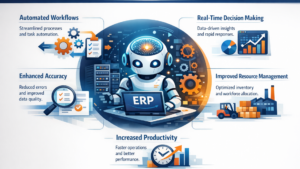
The shift from manual decision-making to Agentic AI-driven decision-making has a profound impact on operational efficiency. By automating routine tasks and improving decision quality, organizations experience several key benefits:
-
Faster Cycle Times
With AI handling decisions, there is no waiting for human input. AI agents can make decisions in near real-time, ensuring that processes such as inventory management, invoicing, and procurement move quickly without delays. This leads to faster cycle times and improved agility, which is crucial in today’s fast-paced business environment.
-
Lower Operational Overhead
By reducing the reliance on human decision-making, Agentic AI helps organizations cut down on operational costs. Employees can focus on high-value tasks that require creativity and strategic thinking, while AI handles routine tasks efficiently.
Automation also reduces the risk of errors, eliminating the need for costly error corrections and manual interventions.
-
Improved Accuracy
AI agents make decisions based on data-driven insights, eliminating human biases and inconsistencies. With accurate, up-to-date data at their disposal, AI systems can make the right decisions every time, whether it’s approving purchase orders, balancing inventory levels, or adjusting credit limits.
Improved accuracy reduces operational risks, enhances customer satisfaction, and increases compliance with regulations.
Moving Beyond Manual ERP Decisions with DAX Software Solutions
At DAX Software Solutions, we help organizations identify high-friction decision points within their existing ERP systems and transform them into AI-driven workflows. By integrating Agentic AI into Microsoft Dynamics 365, we enable businesses to automate decision-making processes, reduce dependency on manual tasks, and increase consistency across operations.
Our approach includes:
- Assessing existing workflows to identify opportunities for AI automation
- Implementing AI agents to make data-driven decisions autonomously
- Ensuring data integrity and governance to support reliable AI decision-making
The result is faster decisions, lower operational costs, and improved accuracy, leading to more efficient and resilient business operations.
Conclusion
Manual decision-making in ERP systems creates significant inefficiencies that lead to delays, errors, and inconsistent outcomes. These inefficiencies accumulate over time, resulting in higher operational costs and missed opportunities. Agentic AI addresses this by automating decision cycles, reducing the dependency on human intervention, and ensuring consistent, data-driven execution. With AI-driven decision-making, organizations can achieve faster cycle times, lower overhead costs, and more accurate outcomes.
At DAX Software Solutions, we specialize in transforming traditional ERP systems into AI-powered decision engines, helping businesses unlock the full potential of Agentic AI and Microsoft Dynamics 365. Because efficiency is not about working harder—it’s about removing unnecessary decisions.
Contact us: https://daxsws.com/contact-us