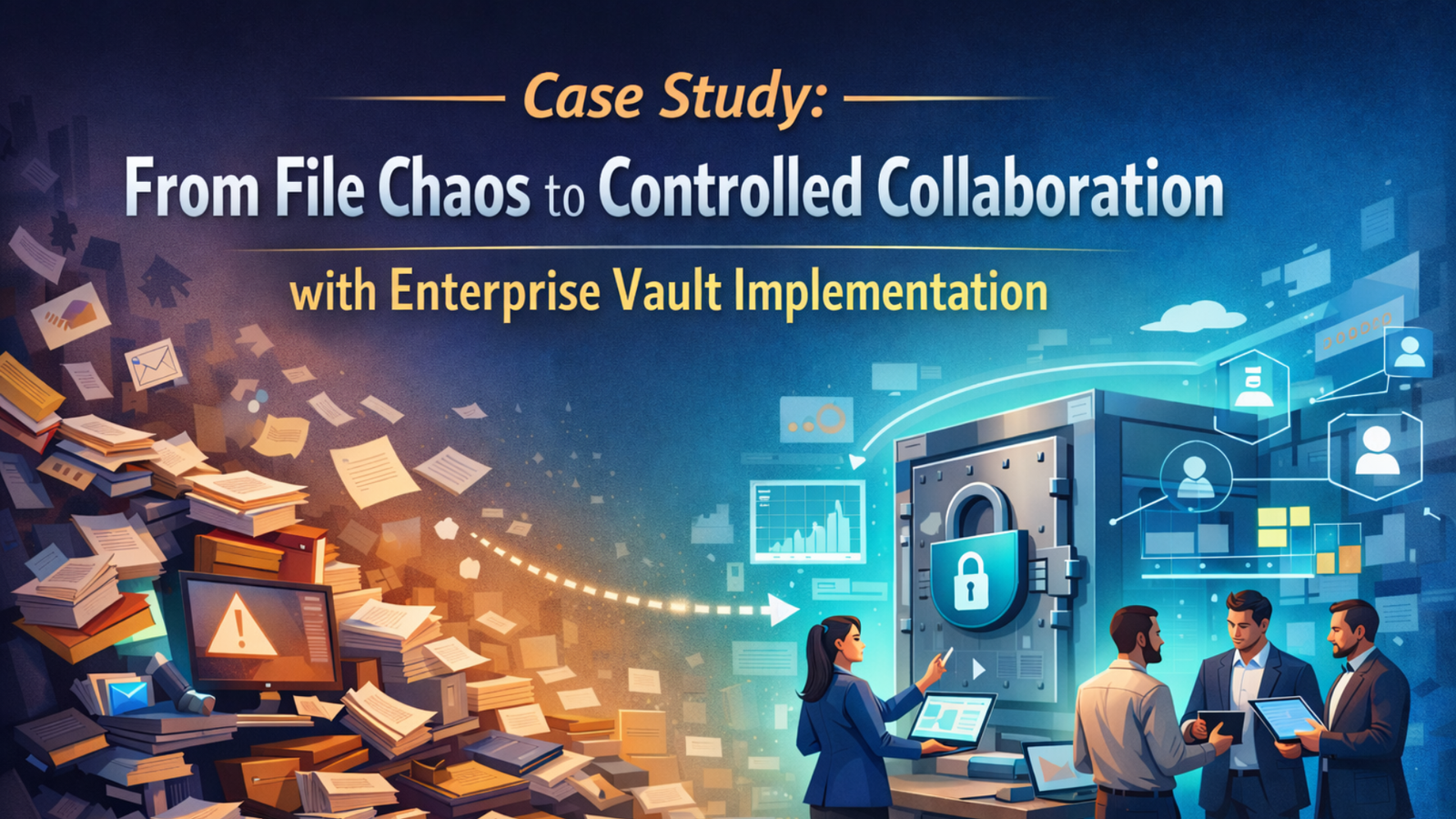
Engineering-driven organizations often underestimate how much operational risk is hidden in unmanaged design data. What begins as a simple file storage challenge can quietly evolve into version conflicts, access control issues, slow collaboration, and growing uncertainty about which data can be trusted. This case examines how a renewable energy organization transitioned from a limited file management setup to an enterprise-grade product data management platform—without disrupting active engineering operations.
Business Context
The organization operates in a project-centric engineering environment where design accuracy, version control, and collaboration across distributed teams are critical. As the volume of CAD files and engineering documentation increased, the limitations of a basic data management tool became increasingly visible. Engineers experienced delays locating the correct versions of files, administrative controls were insufficient for enforcing standards, and system performance degraded as data volumes grew.
The business needed a solution that could scale with its engineering workload while improving data governance, collaboration, and system reliability. Importantly, the transition needed to be executed without risking data integrity or interrupting ongoing design work.
The Core Challenge
The existing setup relied on a basic vault system that was never designed for enterprise-scale collaboration. Key challenges included:
- Limited control over file access and permissions
- Inconsistent versioning and revision history
- Performance bottlenecks as data volumes expanded
- Lack of flexibility to support hybrid cloud or future growth
- Growing operational risk tied to unmanaged engineering data
The organization recognized that incremental fixes would not solve these systemic issues. A structured migration to a more capable platform was required, but the risks of data loss, downtime, or broken references were significant.
Solution Strategy

The engagement began with a clear principle: define readiness before configuration. Rather than immediately deploying new software, the team conducted a comprehensive pre-installation assessment covering infrastructure, security requirements, data structure, and performance considerations.
The chosen approach involved upgrading to Autodesk Vault Professional, deployed in a secure environment that could support either on-premises or cloud-hosted infrastructure. This flexibility ensured alignment with both current operational needs and long-term IT strategy.
Key components of the solution included:
- Installation and configuration of Vault Professional
- Deployment of a dedicated SQL Server instance optimized for performance
- Structured migration of existing file stores and databases
- Validation of file relationships, references, and metadata
- Post-migration testing to ensure stability and usability
Execution and Migration
Migration projects often fail not because of tooling, but because of insufficient planning. To mitigate this, the migration was executed in clearly defined phases.
First, the team validated the existing data environment, identifying potential inconsistencies, orphaned files, and structural risks. This ensured that issues were resolved before data was moved, rather than after.
Next, Vault Professional was installed and configured with role-based access controls, aligning permissions with actual engineering workflows. SQL Server optimization was performed in parallel to ensure that performance would improve rather than degrade post-migration.
The migration itself followed a controlled, structured process. File stores and databases were migrated together to preserve relationships and version history. Extensive validation checks were conducted to confirm that every file, reference, and metadata attribute was intact.
Critically, the migration achieved 100% data transfer with zero loss, allowing engineering teams to resume work without disruption.
Governance and Data Integrity
One of the most valuable outcomes of the project was improved data governance. Vault Professional enabled the organization to enforce consistent rules around file access, versioning, and lifecycle management—without adding administrative overhead.
Validation rules and permission structures ensured that only authorized users could modify critical design data, while auditability improved across the system. Engineers gained confidence that the data they were using was current, approved, and reliable.
This balance between control and usability was central to adoption. The system was designed to support engineers, not slow them down.
Measurable Outcomes
The impact of the implementation was both immediate and measurable:
- Zero data loss during migration
- 35% improvement in system responsiveness following SQL optimization
- Improved collaboration across distributed engineering teams
- Reduced manual effort in managing versions and access
- A scalable platform capable of supporting future growth
Beyond performance metrics, the organization gained something more important: trust in its engineering data.
Why This Matters
Engineering data management is often treated as a back-office concern, but its effects are felt across project delivery, quality, and operational risk. This case demonstrates that modernization is not simply about upgrading software—it is about designing systems that align with how teams actually work.
By prioritizing readiness, data integrity, and governance, the organization transformed a fragile setup into a reliable foundation for collaboration and growth. The result was not just a successful migration, but a system that engineering teams could depend on with confidence.